Tree Planting Scientific Indicators
Evaluation of the Nature for Climate Programme
2025-09-30
Executive summary
About
The Nature for Climate Fund programme (NCF) commissioned a series of indicators to evaluate environmental outcomes directly attributable to the project across five key areas: carbon sequestration, biodiversity, air quality, flood mitigation and water quality. While NCF also aims to generate social and economic uplift through woodland creation, these were outside the scope of this project.
We developed a suite of indicators that can be scaled from site- to programme-level and which reflect, where possible, the influence that the spatial configuration and context of a planting scheme has on its environmental outcomes. This spatial focus allows to unpick where the programme has delivered the “right trees in the right places”, and brings to light regional differences in benefits provided by trees. These indicators have been applied to all planting conducted between 2020 and 2024 under the Planting on Public Land, Planting on Private Land, and Woodland Creation Partnerships workstreams. A final year (2024-2025) of planting is underway to conclude the programme.
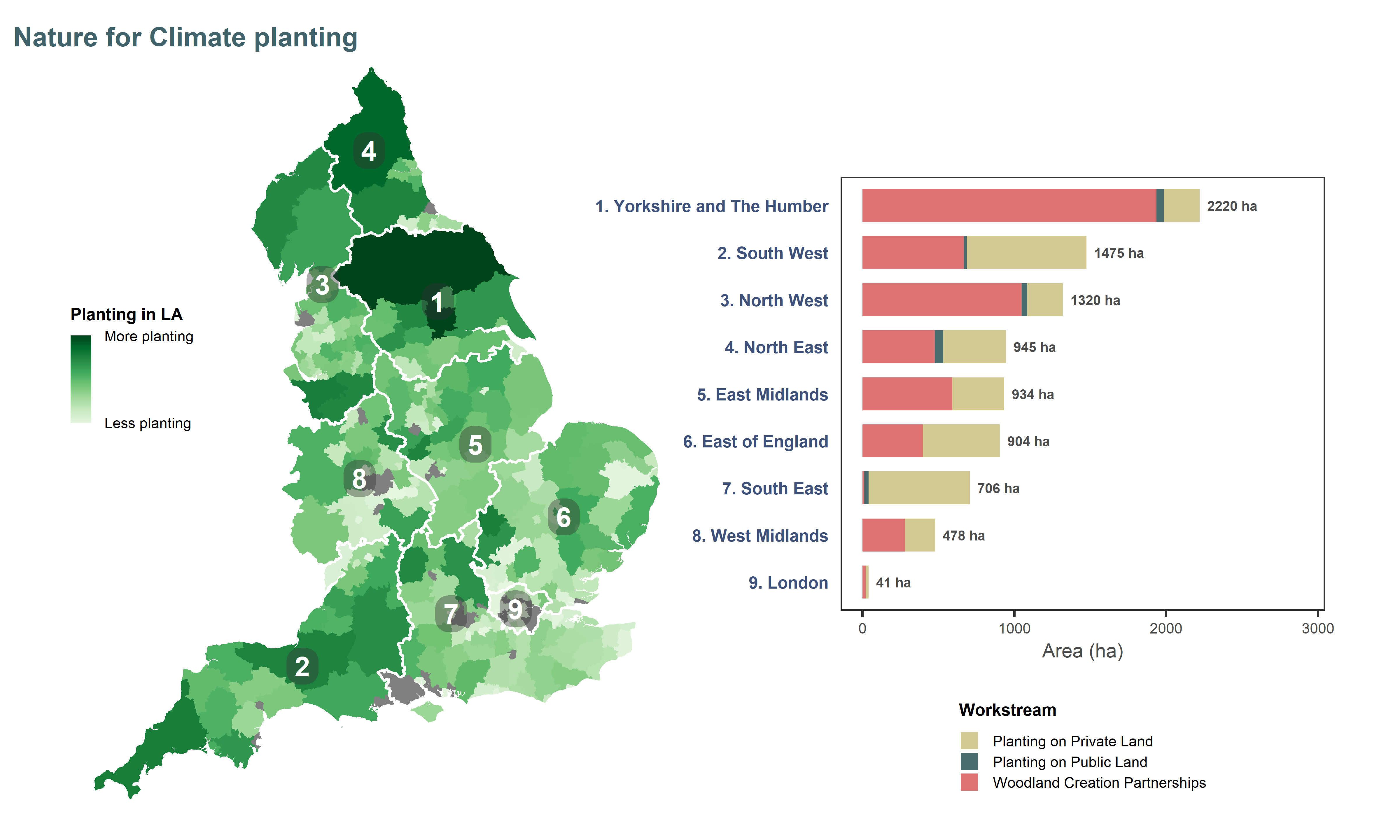
The planting data collected for this project amounts to 5,630 individual planting sites, covering 8,724 ha of declared planting (approx. 11 million trees) across 259 local authorities. This is the most complete spatial view of Nature for Climate planting gathered to date.
Key benefits
The NCF planting (up to 2024) could deliver, compared to the prior land use it replaced, the following benefits by 2050:
- the sequestration of an additional 1.5 to 1.6 million tonnes of CO2
- an expansion of ecological networks between 8,622 and 16,279 hectares for woodland species
- the annual removal of an extra 310 - 336 tonnes of airborne pollutants
- the annual storage of an extra 2.9 Mm3 (millions of cubic meters) of water, contributing to flood regulation
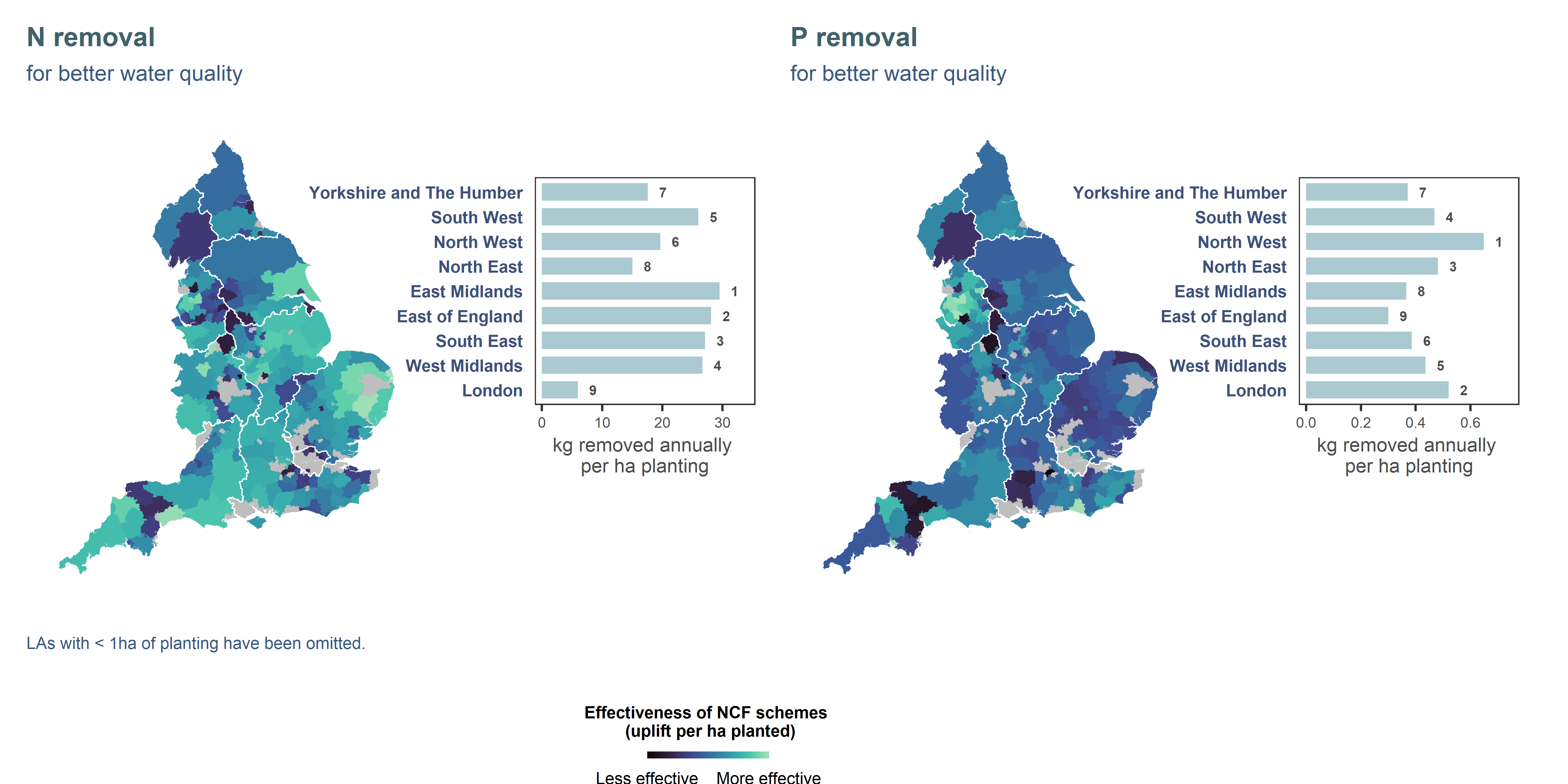
- the annual removal of 202 tonnes of nitrogen and 3.9 tonnes of phosphorus to improve water quality
It is important to note that these are projected potential benefits, conditional on the sites being maintained and managed appropriately. Trees may experience damage or mortality, reducing the magnitude of the realised benefits.
Regional effectiveness of planting
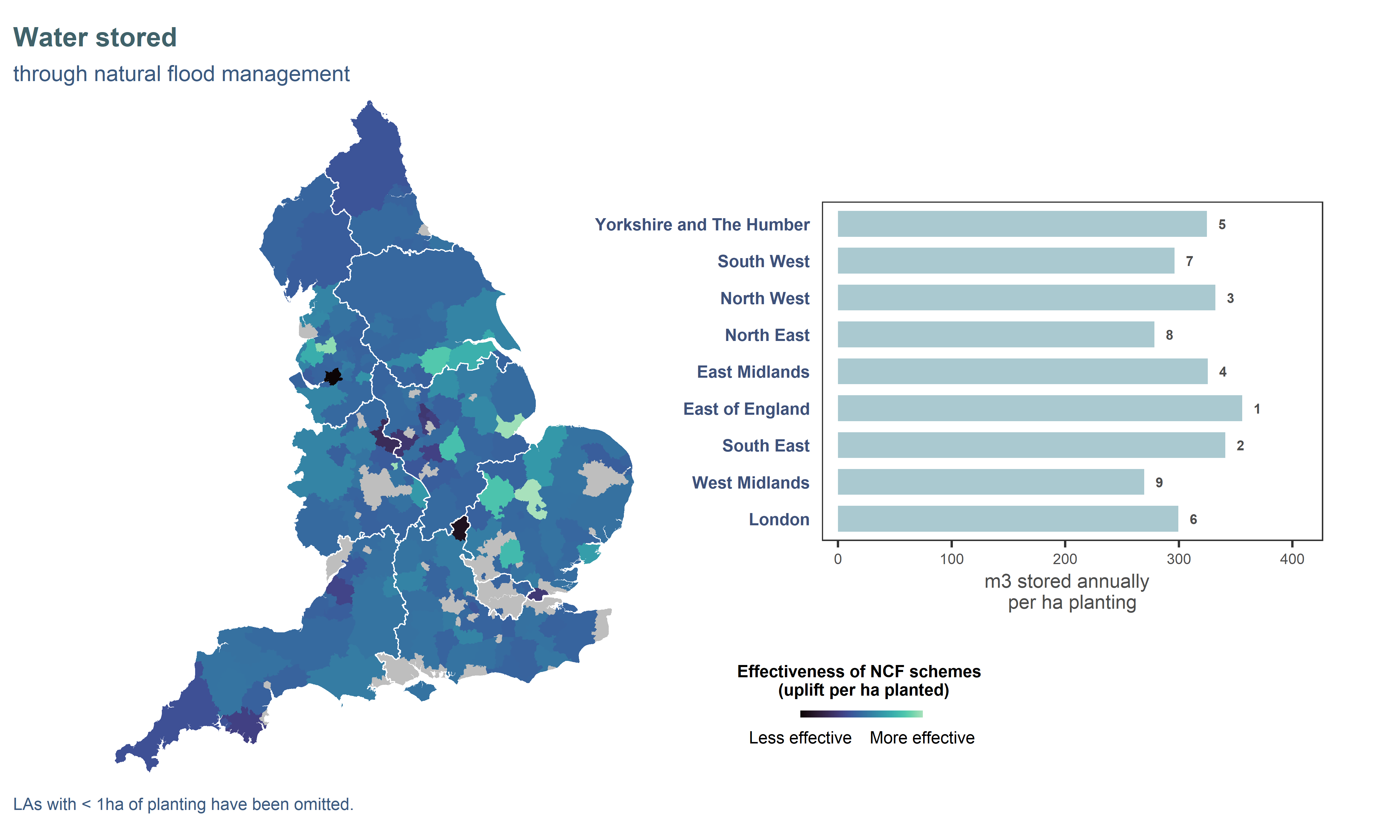
NCF planting is widely but not evenly dispersed across England, with the majority of the planting concentrated in the North. Therefore, reporting benefits only in absolute terms does not allow the exploration of spatial patterns in the delivery of benefits, as they are simply correlated with the amount of planting. We have produced effectiveness metrics for all indicators, defined as the amount of benefits per hectare of planting. The collapsible sections below present a view of those metrics with spatial variability at the LA level (maps) and average regional effectiveness (bar charts).
Effectiveness values provide insight into where NCF planting is especially suited to delivering certain benefits. Note that variations in effectiveness are not a reflection on scheme design or quality, or of different levels of “effort” in tackling issues among regions. Rather, these differences are driven by regional conditions and properties such as climate, soils, dominant land use, pollution levels, etc. The data portal that acts as a companion to this report allows to explore results interactively.
Carbon Sequestration
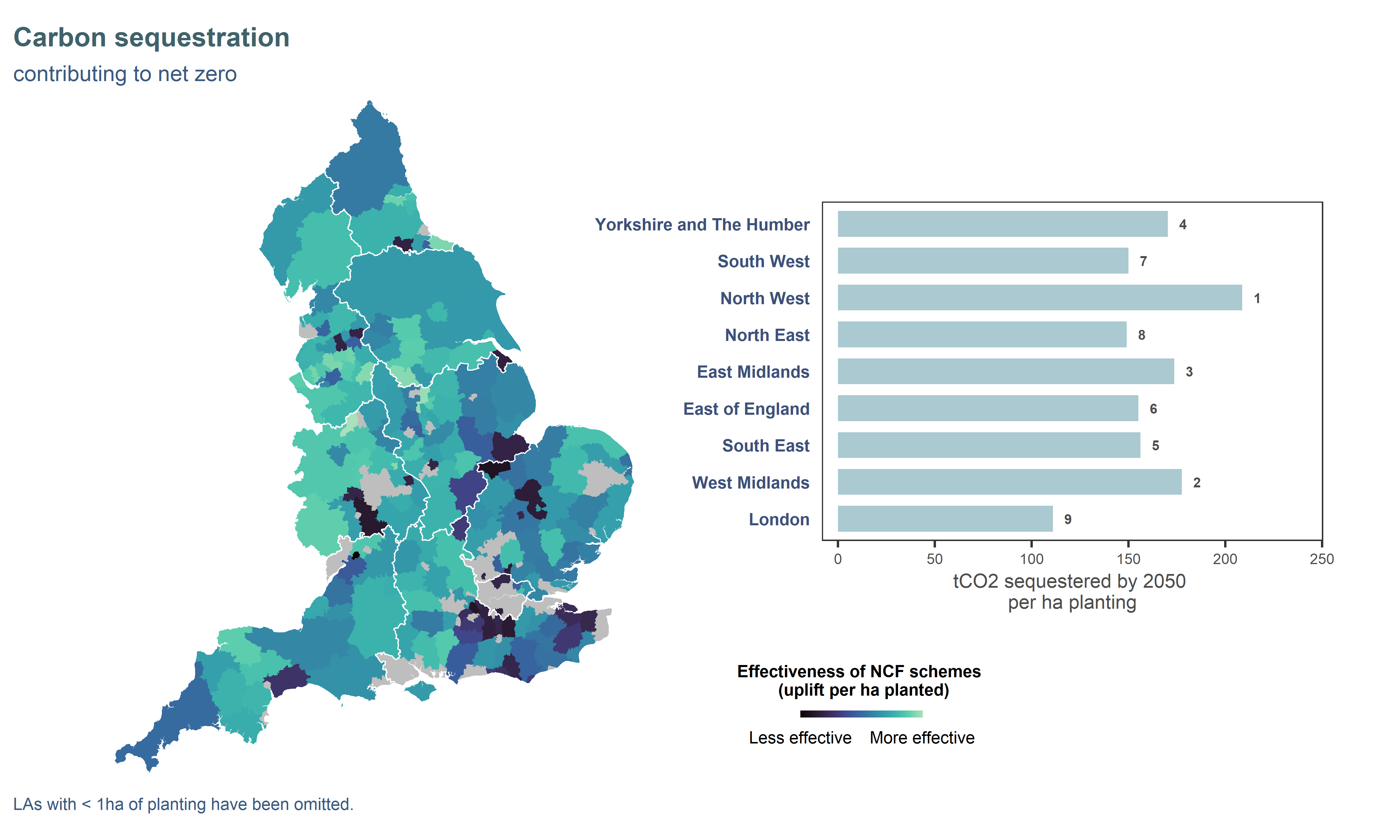
Carbon capture by trees depends on the interaction of species, climate, soils and management at any given location. The effectiveness of NCF sites to capture carbon dioxide is projected to be highest in the North West, a region where yield class (a measure of tree productivity) is predicted to increase significantly for many species under climate change scenarios. (For this analysis, we assumed a standard mix of common species as site-level species data was not available, and modelled results for different spacing and management scenarios.)
Biodiversity
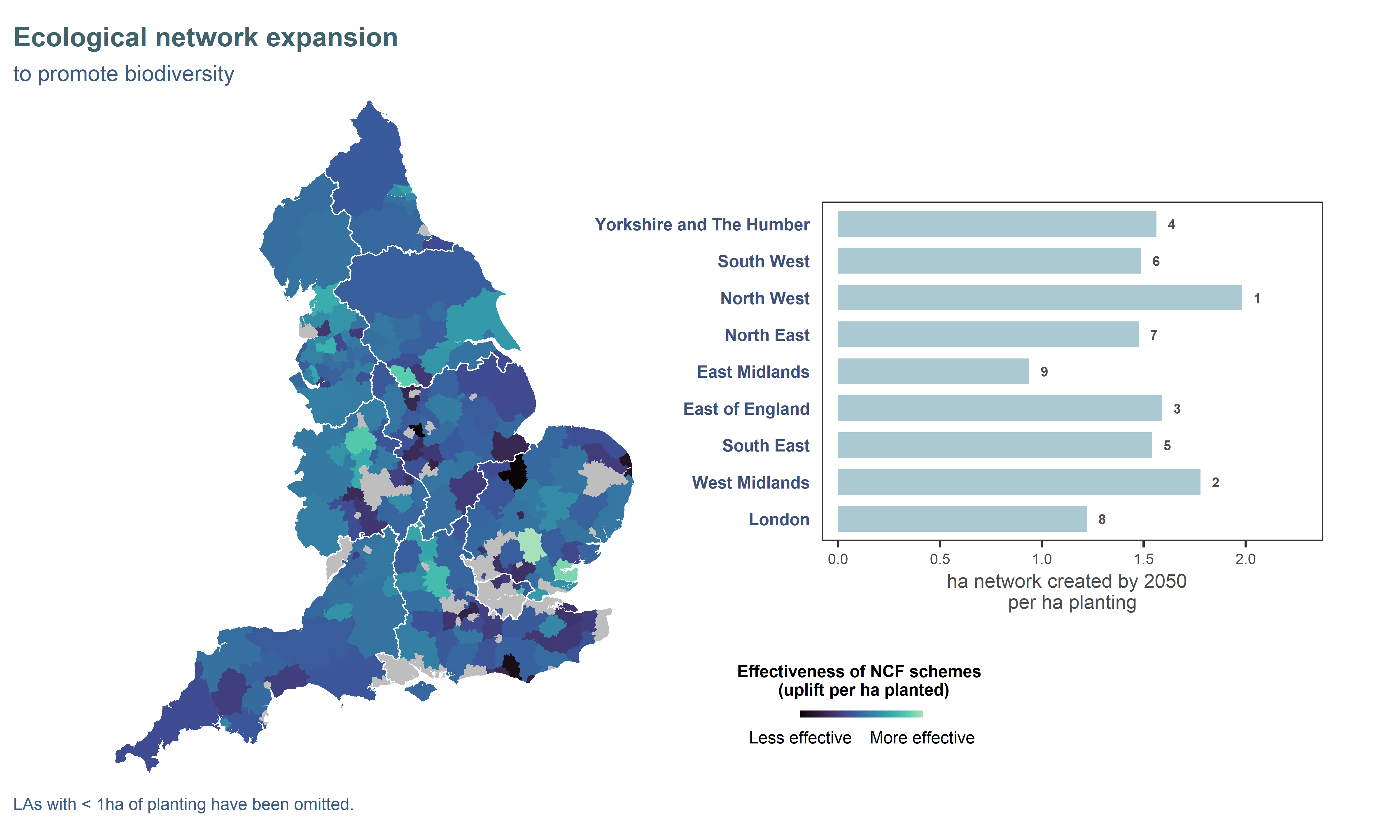
A connected landscape where wildlife can move and disperse within ecological networks allows species to thrive and increase their resilience to threats like climate change. Trees in the North West are projected to be most effective at creating new ecological networks. New woodland creation can expand a network if situated outside but near the existing network. Woodland creation occurring within existing networks still plays a valuable role for biodiversity, but does not contribute to larger networks. Ecological networks were modelled for three dispersal sensitivities: the map shows network expansion under the medium (1km) dispersal scenario.
Air Quality
Pollution removal by vegetation is correlated with pollution levels: the higher the concentration in the air, the more trees can absorb or trap pollutants. It is therefore not surprising that air quality benefits, in terms of amount of pollution removed per hectare planted, are projected to be highest in the London area. NCF schemes in the East Midlands also appear to have a high pollution removal capacity. This region has a lot of arable farming, where soil disturbance can generate dust (particulate matter: PM), and fertiliser applications release ammonia (NH3).
Flood Regulation
Trees can contribute to flood regulation by intercepting rainfall, using up ground water, and acting as a flood barrier to slow down runoff. Due to the coarse resolution of published data, this indicator does not exhibit much spatial variability (similar regional effectiveness). At the local authority level, areas with higher effectiveness are those where a higher proportion of planting is located in the floodplain.
Water Quality
Like with air quality benefits, the removal of nutrients affecting water quality is expected to be highest in areas where inputs (such as fertilisers and animal manure) are high to begin with. For nitrogen (N), these are regions where arable farming is important. For phosphorus (P), the effectiveness is highest in the North, where the wetter climate and hilly topography increase runoff and export of this pollutant. Trees mostly contribute to better water quality through the cessation of inputs, but also change soil properties and slow the flow of water, limiting erosion and runoff.
Technical lead, S.AngersBlondin@ljmu.ac.uk↩︎
NC Hub lead, C.Bowe@ljmu.ac.uk↩︎